Russia is expanding its neonatal screening program for rare diseases.
Published 31 August 2026
Last update 31 August 2026
234
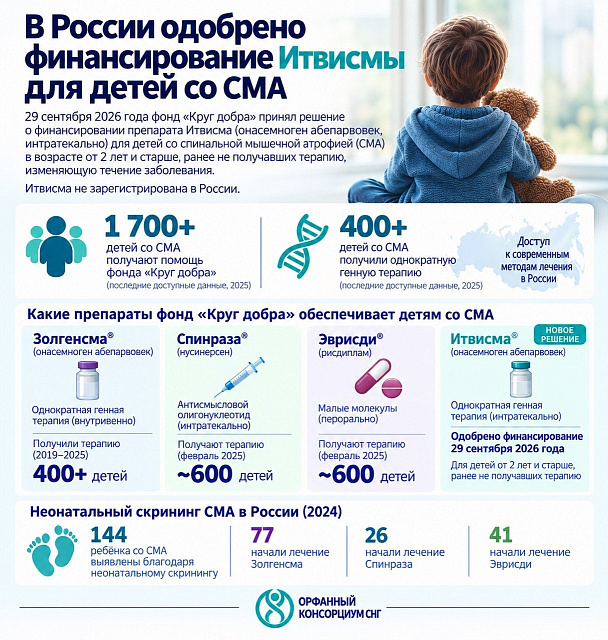
In Russia, the expansion of the neonatal screening programme for rare diseases continues. This is happening against the backdrop of significant funding for drug therapy for children with severe and orphan diseases.
 Expansion of the Screening Programme
In August, the Russian Ministry of Health confirmed previously announced plans for further expansion of the programme.
As of 1 April 2026, the number of diseases for which newborns are screened increased from 36 to 38. The following were added to the programme:
— X-linked adrenoleukodystrophy
— aromatic L-amino acid decarboxylase (AADC) deficiency
In 2027, it is planned to add another 6 diseases:
— Duchenne muscular dystrophy
— Pompe disease
— mucopolysaccharidosis type I
— Gaucher disease
— Niemann–Pick disease types A/B
— Krabbe disease
Thus, the programme may be expanded to 44 diseases.
In subsequent years, the inclusion of another 5 rare diseases is being considered, which could potentially increase screening coverage to 49 diseases.
 Funding for Drug Therapy
The expansion of early diagnosis is occurring against the backdrop of significant funding for drug provision.
In 2025, through the mechanisms of the "Circle of Good" foundation, 180.1 billion roubles were allocated for drug provision.
Of which:
— 91.1 billion roubles — for drugs registered in Russia
— 68.2 billion roubles — for unregistered drugs
— 20.5 billion roubles — for drug provision for children under the "14 VZN" programme
 Procurement Growth in 2026
According to Headway Company, in January–July 2026, the volume of drug procurement for the "Circle of Good" foundation amounted to 62.69 billion roubles, compared to 15.29 billion roubles in the same period of 2025.
Thus, procurement volume increased more than 4-fold.
 Most Costly Items
Expenditures are highly concentrated on a few expensive technologies.
The largest items in January–July 2026 were:
— "Trilexa" — 14.8 billion roubles (24% of procurement volume)
— "Evrysdi" — 9.54 billion roubles (15%)
— "Koseleugo" — 7.06 billion roubles (11%)
— "Translarna" — 6.07 billion roubles (10%)
Together, these four drugs alone account for about 60% of the foundation's procurement.
 Why This Matters
The expansion of neonatal screening makes it possible to identify patients earlier and initiate therapy before the development of irreversible complications.
At the same time, increased detection rates will increase the number of patients in need of expensive treatment. This heightens the importance of:
— demand forecasting
— budget impact assessment of new technologies
— systematic horizon scanning
— long-term planning for the sustainability of rare disease drug provision
 Source: RIA Novosti
Expansion of the Screening ProgrammeIn August, the Russian Ministry of Health confirmed previously announced plans for further expansion of the programme.
As of 1 April 2026, the number of diseases for which newborns are screened increased from 36 to 38. The following were added to the programme:
— X-linked adrenoleukodystrophy
— aromatic L-amino acid decarboxylase (AADC) deficiency
In 2027, it is planned to add another 6 diseases:
— Duchenne muscular dystrophy
— Pompe disease
— mucopolysaccharidosis type I
— Gaucher disease
— Niemann–Pick disease types A/B
— Krabbe disease
Thus, the programme may be expanded to 44 diseases.
In subsequent years, the inclusion of another 5 rare diseases is being considered, which could potentially increase screening coverage to 49 diseases.
Funding for Drug TherapyThe expansion of early diagnosis is occurring against the backdrop of significant funding for drug provision.
In 2025, through the mechanisms of the "Circle of Good" foundation, 180.1 billion roubles were allocated for drug provision.
Of which:
— 91.1 billion roubles — for drugs registered in Russia
— 68.2 billion roubles — for unregistered drugs
— 20.5 billion roubles — for drug provision for children under the "14 VZN" programme
Procurement Growth in 2026According to Headway Company, in January–July 2026, the volume of drug procurement for the "Circle of Good" foundation amounted to 62.69 billion roubles, compared to 15.29 billion roubles in the same period of 2025.
Thus, procurement volume increased more than 4-fold.
Most Costly ItemsExpenditures are highly concentrated on a few expensive technologies.
The largest items in January–July 2026 were:
— "Trilexa" — 14.8 billion roubles (24% of procurement volume)
— "Evrysdi" — 9.54 billion roubles (15%)
— "Koseleugo" — 7.06 billion roubles (11%)
— "Translarna" — 6.07 billion roubles (10%)
Together, these four drugs alone account for about 60% of the foundation's procurement.
Why This MattersThe expansion of neonatal screening makes it possible to identify patients earlier and initiate therapy before the development of irreversible complications.
At the same time, increased detection rates will increase the number of patients in need of expensive treatment. This heightens the importance of:
— demand forecasting
— budget impact assessment of new technologies
— systematic horizon scanning
— long-term planning for the sustainability of rare disease drug provision
Source: RIA Novosti