Draft guidance on pediatric clinical trials tabled by ECE
Published 27 October 2026
Last update 03 November 2026
63
The Eurasian Economic Commission has published for public consultation a draft guidance on conducting clinical trials in the paediatric population.
The document clarifies how to plan studies in children within the overall drug development programme, justify efficacy, safety, and dosing, and use already obtained clinical data. The consultation will run until 11 November 2026. EEC draft card.
 Why This Matters
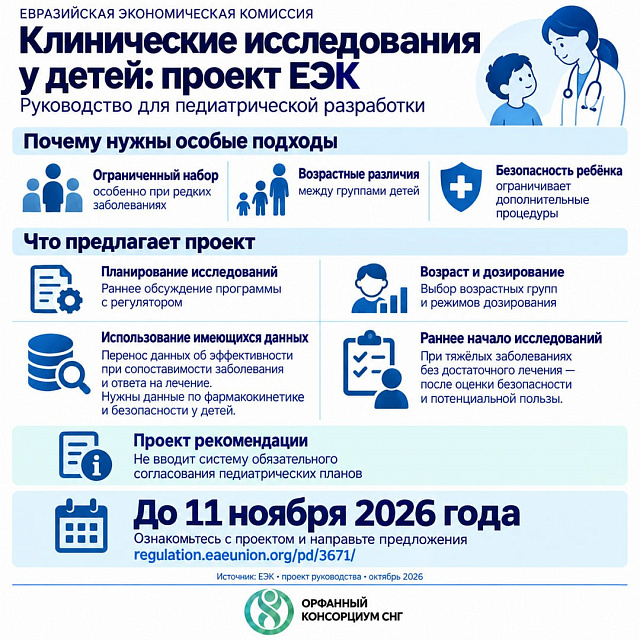
Conducting studies in children entails particular difficulties. Participant recruitment is limited, especially in rare diseases, and age-related differences make it difficult to obtain data applicable to the entire paediatric population.
Additional tests and procedures must be limited with due regard for the child's safety and well-being.
All of this complicates and increases the cost of research, while the small market for individual paediatric drugs reduces manufacturers' commercial interest. As a result, shortages of clinical data, incomplete labelling, and a lack of authorised paediatric dosage forms persist. Drugs are often used off-label — outside the authorised conditions of use. These barriers are discussed in an article by N.Z. Musina and A.G. Rumyantsev.
 What the Draft Proposes
The guidance will help developers justify the scope of studies, select age groups and dosing regimens, use available data, and reduce unnecessary burden on participants.
In particular, the draft provides for:
• Use of efficacy data from adults or older children where the pathogenesis of the disease and the expected treatment response are comparable. At the same time, relevant pharmacokinetic and safety data in children must be obtained.
• Earlier initiation of paediatric studies in serious or life-threatening diseases for which treatment is unavailable or limited — after assessment of initial safety data and justification of potential benefit.
• Early discussion of the paediatric programme with the regulator, including timelines, required studies, and specifics of paediatric dosage forms. These approaches are set out in the draft guidance.
 Methodological Approaches and Developer Obligations
The document has been prepared as a recommendation and does not in itself introduce a system of mandatory paediatric development agreement comparable to the mechanisms of the EU and the US.
In the EU, a paediatric investigation plan — PIP applies; in the US, an initial paediatric study plan — iPSP under the PREA law. In cases provided for by legislation, the developer must agree the paediatric study programme in advance or justify a waiver or deferral of studies. Such requirements are described in the materials of the EMA and FDA.
For Russia and other EAEU countries, it is important to continue discussion of obligations for planning paediatric development, economic incentives, and support for research in commercially unattractive areas. Taken together, these measures can contribute to the expansion of authorisation of paediatric indications, dosages, and dosage forms.
 We invite colleagues to review the draft and submit comments and proposals by 11 November 2026 via the EEC public consultation portal.
 This issue is addressed in the article by our colleagues N.Z. Musina and A.G. Rumyantsev «Accessibility of Medicinal Products for Children: Issues of Improving Regulation», published in the journal "Pediatriya" named after G.N. Speransky. The authors analyse the barriers to paediatric development, international experience, and directions for improving regulation.
The document clarifies how to plan studies in children within the overall drug development programme, justify efficacy, safety, and dosing, and use already obtained clinical data. The consultation will run until 11 November 2026. EEC draft card.
Why This MattersConducting studies in children entails particular difficulties. Participant recruitment is limited, especially in rare diseases, and age-related differences make it difficult to obtain data applicable to the entire paediatric population.
Additional tests and procedures must be limited with due regard for the child's safety and well-being.
All of this complicates and increases the cost of research, while the small market for individual paediatric drugs reduces manufacturers' commercial interest. As a result, shortages of clinical data, incomplete labelling, and a lack of authorised paediatric dosage forms persist. Drugs are often used off-label — outside the authorised conditions of use. These barriers are discussed in an article by N.Z. Musina and A.G. Rumyantsev.
What the Draft ProposesThe guidance will help developers justify the scope of studies, select age groups and dosing regimens, use available data, and reduce unnecessary burden on participants.
In particular, the draft provides for:
• Use of efficacy data from adults or older children where the pathogenesis of the disease and the expected treatment response are comparable. At the same time, relevant pharmacokinetic and safety data in children must be obtained.
• Earlier initiation of paediatric studies in serious or life-threatening diseases for which treatment is unavailable or limited — after assessment of initial safety data and justification of potential benefit.
• Early discussion of the paediatric programme with the regulator, including timelines, required studies, and specifics of paediatric dosage forms. These approaches are set out in the draft guidance.
Methodological Approaches and Developer ObligationsThe document has been prepared as a recommendation and does not in itself introduce a system of mandatory paediatric development agreement comparable to the mechanisms of the EU and the US.
In the EU, a paediatric investigation plan — PIP applies; in the US, an initial paediatric study plan — iPSP under the PREA law. In cases provided for by legislation, the developer must agree the paediatric study programme in advance or justify a waiver or deferral of studies. Such requirements are described in the materials of the EMA and FDA.
For Russia and other EAEU countries, it is important to continue discussion of obligations for planning paediatric development, economic incentives, and support for research in commercially unattractive areas. Taken together, these measures can contribute to the expansion of authorisation of paediatric indications, dosages, and dosage forms.
We invite colleagues to review the draft and submit comments and proposals by 11 November 2026 via the EEC public consultation portal. This issue is addressed in the article by our colleagues N.Z. Musina and A.G. Rumyantsev «Accessibility of Medicinal Products for Children: Issues of Improving Regulation», published in the journal "Pediatriya" named after G.N. Speransky. The authors analyse the barriers to paediatric development, international experience, and directions for improving regulation.