UK rolls out parallel drug expertise for registration and public funding
Published 16 November 2026
Last update 16 November 2026
2
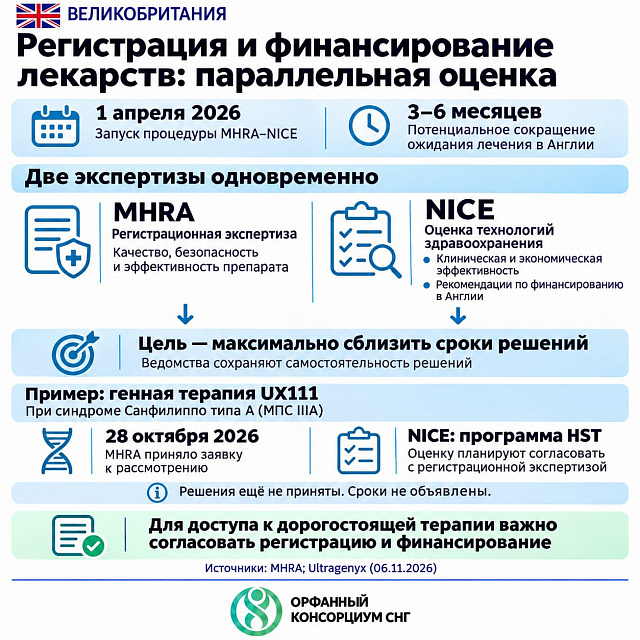
Since April 1, 2026, the United Kingdom has had a coordinated procedure in place that allows registration review and health technology assessment to be conducted in parallel. According to the agencies' estimates, this could bring access for patients in England to certain new medicines forward by 3–6 months. MHRA announcement.
 How the mechanism works
The agencies' tasks differ:
— The MHRA, the Medicines and Healthcare products Regulatory Agency, assesses the quality, safety, and efficacy of a medicine for its registration.
— NICE, the National Institute for Health and Care Excellence, assesses clinical and cost-effectiveness and develops recommendations on funding treatment in England.
The procedure allows the review timelines to be coordinated so as to bring the decisions as close together as possible. Participation is voluntary, and both agencies retain their independence and their own assessment standards. Description of the MHRA–NICE procedure.
 Example — gene therapy for Sanfilippo syndrome
On October 28, 2026, the MHRA accepted for review Ultragenyx's application for registration of UX111 — a gene therapy for mucopolysaccharidosis IIIA, or Sanfilippo syndrome type A.
According to the company, the NICE assessment will be aligned in timing with the registration review so that the funding decision is made as close as possible to the possible approval of the medicine.
The therapy has been referred to NICE's Highly Specialised Technologies (HST) programme for the assessment of treatments for ultra-rare severe diseases. Specific decision timelines have not yet been announced. Acceptance of the application for review does not yet mean approval of the medicine.
Sanfilippo syndrome type A causes progressive brain damage with loss of speech, cognitive, and motor functions. UX111 is intended for a single intravenous administration and delivery of a functional copy of the gene needed to produce the missing enzyme. With this disease, waiting time for treatment is critical. Ultragenyx announcement of November 6, 2026.
 International experience
Parallel review of registration applications and materials for funding assessment is also used in Canada and Australia.
In the European Union, a joint clinical assessment of certain categories of medicines, including gene therapy, is conducted in parallel with registration review. At the same time, decisions on prices and funding remain at the national level. European Commission
 Why this matters
For expensive gene therapy, coordinating timelines is especially significant. Paying out of pocket is unaffordable for most families, so registration without funding does not ensure real access to treatment.
Patients and manufacturers need to understand the prospects for state funding in advance.
How the mechanism worksThe agencies' tasks differ:
— The MHRA, the Medicines and Healthcare products Regulatory Agency, assesses the quality, safety, and efficacy of a medicine for its registration.
— NICE, the National Institute for Health and Care Excellence, assesses clinical and cost-effectiveness and develops recommendations on funding treatment in England.
The procedure allows the review timelines to be coordinated so as to bring the decisions as close together as possible. Participation is voluntary, and both agencies retain their independence and their own assessment standards. Description of the MHRA–NICE procedure.
Example — gene therapy for Sanfilippo syndromeOn October 28, 2026, the MHRA accepted for review Ultragenyx's application for registration of UX111 — a gene therapy for mucopolysaccharidosis IIIA, or Sanfilippo syndrome type A.
According to the company, the NICE assessment will be aligned in timing with the registration review so that the funding decision is made as close as possible to the possible approval of the medicine.
The therapy has been referred to NICE's Highly Specialised Technologies (HST) programme for the assessment of treatments for ultra-rare severe diseases. Specific decision timelines have not yet been announced. Acceptance of the application for review does not yet mean approval of the medicine.
Sanfilippo syndrome type A causes progressive brain damage with loss of speech, cognitive, and motor functions. UX111 is intended for a single intravenous administration and delivery of a functional copy of the gene needed to produce the missing enzyme. With this disease, waiting time for treatment is critical. Ultragenyx announcement of November 6, 2026.
International experienceParallel review of registration applications and materials for funding assessment is also used in Canada and Australia.
In the European Union, a joint clinical assessment of certain categories of medicines, including gene therapy, is conducted in parallel with registration review. At the same time, decisions on prices and funding remain at the national level. European Commission
Why this mattersFor expensive gene therapy, coordinating timelines is especially significant. Paying out of pocket is unaffordable for most families, so registration without funding does not ensure real access to treatment.
Patients and manufacturers need to understand the prospects for state funding in advance.