Uzbekistan develops a universal system of drug reimbursement
Published 12 October 2026
Last update 12 October 2026
The Ministry of Health of Uzbekistan has reported on the implementation of the medicines reimbursement programme. Launched in 2022 as a pilot project in the Syrdarya region, it is gradually being extended to other regions of the country.
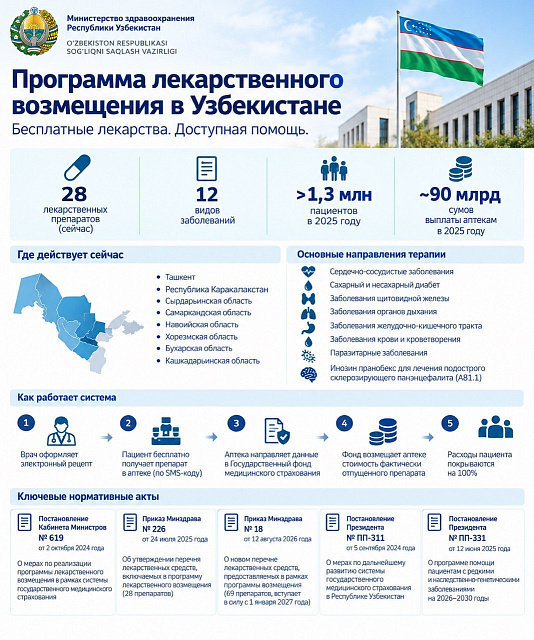
According to published data from the State Health Insurance Fund, the programme covers eight territories: Tashkent, the Republic of Karakalpakstan, and the Syrdarya, Samarkand, Navoi, Khorezm, Bukhara, and Kashkadarya regions. By the end of 2026, it is planned to extend it to the entire country.
 At the start, patients were provided free of charge with 11 medicines for the treatment of five types of diseases. Today the list has been expanded to 28 medicines for 12 types of diseases, and from 1 January 2027 it will include 69 medicinal products. The expansion is set out in an order of the Ministry of Health registered under No. 3822.
Among the areas covered are cardiovascular diseases, type 2 diabetes mellitus, diabetes insipidus, thyroid diseases, respiratory diseases, gastrointestinal diseases, blood and haematopoietic diseases, as well as parasitic diseases. The programme also covers subacute sclerosing panencephalitis (A81.1) — a rare disease. For patients with this diagnosis, the approved list includes inosine pranobex.
 The system currently covers a limited list of diseases. However, what is fundamentally important is the development of the medicines reimbursement mechanism itself: the doctor issues an electronic prescription, the patient receives the programme medicine free of charge at a pharmacy that has concluded an agreement with the Fund, and the Fund reimburses the pharmacy for the cost of the medicine actually dispensed within the established amounts. The patient does not pay for the programme medicine. The procedure is set out in Resolution of the Cabinet of Ministers No. 619 dated 2 October 2024.
The principle of access is also important: the basis is the disease, medical indications, and the prescription of a medicine included in the programme, rather than the patient's belonging to a particular social or benefit category. It is in this sense that the system forms the basis for universal medicines reimbursement, although the list of covered diseases and medicines remains limited for now.
 In 2025, more than 1.3 million patients received free medicines under the programme. Over 2.5 million electronic prescriptions were issued, and payments to pharmacies amounted to about 90 billion soums. These figures are cited by the State Health Insurance Fund.
 For rare diseases, a separate system of medicinal provision operates in parallel. The programme for 2026–2030 provides for assistance with 10 groups of diseases and the provision of 13 medicinal products. From 2026, free follow-up and treatment continue after reaching adulthood — up to and including the age of 21. The basis is Resolution of the President No. PP-331.
 For now, the reimbursement list remains small, but the mechanism created allows new diseases and medicines to be progressively included in it. For patients with rare diseases, both the further expansion of this programme and the development of separate orphan medicinal provision will be important.
According to published data from the State Health Insurance Fund, the programme covers eight territories: Tashkent, the Republic of Karakalpakstan, and the Syrdarya, Samarkand, Navoi, Khorezm, Bukhara, and Kashkadarya regions. By the end of 2026, it is planned to extend it to the entire country.
At the start, patients were provided free of charge with 11 medicines for the treatment of five types of diseases. Today the list has been expanded to 28 medicines for 12 types of diseases, and from 1 January 2027 it will include 69 medicinal products. The expansion is set out in an order of the Ministry of Health registered under No. 3822.Among the areas covered are cardiovascular diseases, type 2 diabetes mellitus, diabetes insipidus, thyroid diseases, respiratory diseases, gastrointestinal diseases, blood and haematopoietic diseases, as well as parasitic diseases. The programme also covers subacute sclerosing panencephalitis (A81.1) — a rare disease. For patients with this diagnosis, the approved list includes inosine pranobex.
The system currently covers a limited list of diseases. However, what is fundamentally important is the development of the medicines reimbursement mechanism itself: the doctor issues an electronic prescription, the patient receives the programme medicine free of charge at a pharmacy that has concluded an agreement with the Fund, and the Fund reimburses the pharmacy for the cost of the medicine actually dispensed within the established amounts. The patient does not pay for the programme medicine. The procedure is set out in Resolution of the Cabinet of Ministers No. 619 dated 2 October 2024.The principle of access is also important: the basis is the disease, medical indications, and the prescription of a medicine included in the programme, rather than the patient's belonging to a particular social or benefit category. It is in this sense that the system forms the basis for universal medicines reimbursement, although the list of covered diseases and medicines remains limited for now.
In 2025, more than 1.3 million patients received free medicines under the programme. Over 2.5 million electronic prescriptions were issued, and payments to pharmacies amounted to about 90 billion soums. These figures are cited by the State Health Insurance Fund. For rare diseases, a separate system of medicinal provision operates in parallel. The programme for 2026–2030 provides for assistance with 10 groups of diseases and the provision of 13 medicinal products. From 2026, free follow-up and treatment continue after reaching adulthood — up to and including the age of 21. The basis is Resolution of the President No. PP-331. For now, the reimbursement list remains small, but the mechanism created allows new diseases and medicines to be progressively included in it. For patients with rare diseases, both the further expansion of this programme and the development of separate orphan medicinal provision will be important.