FDA begins to develop a unified concept for the development and evaluation of orphan drugs
Published 16 October 2026
Last update 16 October 2026
1
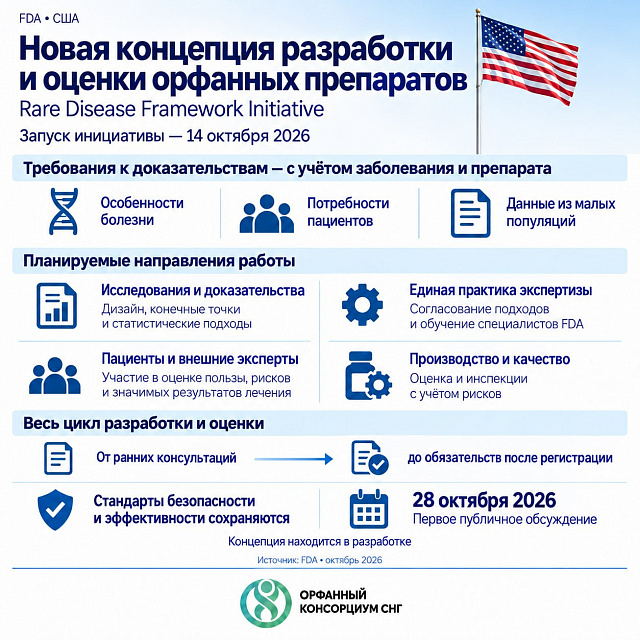
On 14 October 2026, the FDA announced the launch of the Rare Disease Framework Initiative. The goal of the initiative is to bring together accumulated experience in supporting orphan development into a consistent and predictable system of regulatory work.
In recent years, the FDA has created numerous programmes for rare diseases. They help improve research, engage patients and experts, and accelerate therapy development. Now the agency intends to systematise these approaches and ensure their consistent application across different expert divisions. This is stated in the FDA announcement.
 The core principle of the future concept is the adaptation of evidentiary requirements to the specific disease and drug. It is envisaged to take into account the onset and nature of disease progression, the characteristics of patients, their needs, and the data that can realistically be obtained in a small population. These expectations should be explained more clearly to developers throughout the development and review process.
Among the possible outcomes, the FDA lists:
• revision of existing and development of new methodological guidances on study design, endpoints, statistical approaches, and post-authorisation commitments;
• consideration of changes to regulatory norms;
• alignment of review practices between the divisions assessing medicinal and biological products;
• training of FDA experts and managers in the application of new approaches.
 More systematic patient involvement is envisaged in defining meaningful treatment outcomes and assessing benefit and risk, along with engagement of external rare disease specialists and development of shared expert resources.
A separate direction is a risk-based approach to the assessment of manufacturing, quality control, and the conduct of pre-authorisation inspections.
The concept is intended to cover the entire process: from early consultations with the developer to post-authorisation commitments. At the same time, the legislative standards of safety and efficacy are preserved. These principles are set out in the FDA concept paper.
 The work is at an early stage. On 28 October 2026, the FDA will hold the first public discussion of the initiative. This will be followed by thematic roundtables and the collection of proposals from patients, researchers, clinicians, and developers.
In recent years, the FDA has created numerous programmes for rare diseases. They help improve research, engage patients and experts, and accelerate therapy development. Now the agency intends to systematise these approaches and ensure their consistent application across different expert divisions. This is stated in the FDA announcement.
The core principle of the future concept is the adaptation of evidentiary requirements to the specific disease and drug. It is envisaged to take into account the onset and nature of disease progression, the characteristics of patients, their needs, and the data that can realistically be obtained in a small population. These expectations should be explained more clearly to developers throughout the development and review process.Among the possible outcomes, the FDA lists:
• revision of existing and development of new methodological guidances on study design, endpoints, statistical approaches, and post-authorisation commitments;
• consideration of changes to regulatory norms;
• alignment of review practices between the divisions assessing medicinal and biological products;
• training of FDA experts and managers in the application of new approaches.
More systematic patient involvement is envisaged in defining meaningful treatment outcomes and assessing benefit and risk, along with engagement of external rare disease specialists and development of shared expert resources.A separate direction is a risk-based approach to the assessment of manufacturing, quality control, and the conduct of pre-authorisation inspections.
The concept is intended to cover the entire process: from early consultations with the developer to post-authorisation commitments. At the same time, the legislative standards of safety and efficacy are preserved. These principles are set out in the FDA concept paper.
The work is at an early stage. On 28 October 2026, the FDA will hold the first public discussion of the initiative. This will be followed by thematic roundtables and the collection of proposals from patients, researchers, clinicians, and developers.