FDA launches drug expert review sharing program to speed up registration in other countries
Published 18 November 2026
Last update 19 November 2026
2
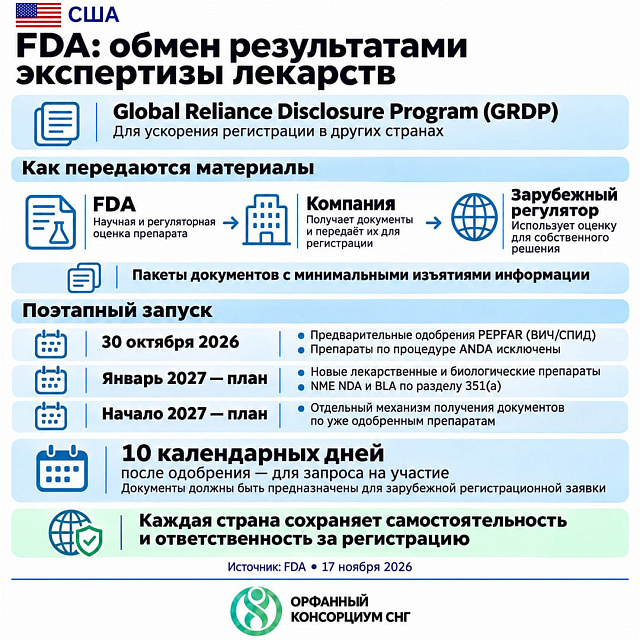
On November 17, 2026, the FDA announced the launch of the Global Reliance Disclosure Program (GRDP). The goal is to reduce delays between a medicine's approval in the United States and its registration in other countries.
 How the program works
Companies will be able to obtain approval document packages with minimal redactions of information, including the FDA's detailed scientific and regulatory assessment. These materials can then be shared with foreign regulators for review of a registration application.
 Phased expansion
 Since October 30, 2026, the program has been available for tentative approvals under the U.S. President's Emergency Plan for AIDS Relief PEPFAR. Medicines submitted under the abbreviated new drug application procedure ANDA are excluded.
From January 2027, the FDA plans to expand the program to new drug and biological products reviewed under the NME NDA and section 351(a) BLA procedures.
In early 2027, a separate mechanism for expedited obtaining of documents on already approved medicines is also planned.
 Conditions of participation
A company must submit a request within 10 calendar days after approval and confirm that the documents are intended for submission of a registration application to a foreign regulator. The FDA plans to provide the materials on an expedited basis. Official FDA announcement.
 Use of another regulator's review results
The initiative develops the regulatory reliance approach supported by WHO. It involves using the review results of another competent regulator when making one's own decision.
This makes it possible to reduce duplication of work and direct resources to tasks requiring national oversight, including pharmacovigilance and supervision of the circulation of medicines. At the same time, each country retains independence and responsibility for registration. WHO recommendations on regulatory reliance.
 Why this matters for orphan medicines
For orphan medicines, this possibility may be of particular importance: limited clinical data increases the importance of making the fullest possible use of already accumulated evidence and the results of its assessment.
Access to the FDA's detailed review can help national specialists in other countries understand the grounds for a positive decision, approaches to interpreting the data, and remaining uncertainties. This creates an opportunity to reduce duplicate work and speed up review of an application while retaining the national regulator's responsibility.
How the program worksCompanies will be able to obtain approval document packages with minimal redactions of information, including the FDA's detailed scientific and regulatory assessment. These materials can then be shared with foreign regulators for review of a registration application.
Phased expansion Since October 30, 2026, the program has been available for tentative approvals under the U.S. President's Emergency Plan for AIDS Relief PEPFAR. Medicines submitted under the abbreviated new drug application procedure ANDA are excluded. From January 2027, the FDA plans to expand the program to new drug and biological products reviewed under the NME NDA and section 351(a) BLA procedures. In early 2027, a separate mechanism for expedited obtaining of documents on already approved medicines is also planned. Conditions of participationA company must submit a request within 10 calendar days after approval and confirm that the documents are intended for submission of a registration application to a foreign regulator. The FDA plans to provide the materials on an expedited basis. Official FDA announcement.
Use of another regulator's review resultsThe initiative develops the regulatory reliance approach supported by WHO. It involves using the review results of another competent regulator when making one's own decision.
This makes it possible to reduce duplication of work and direct resources to tasks requiring national oversight, including pharmacovigilance and supervision of the circulation of medicines. At the same time, each country retains independence and responsibility for registration. WHO recommendations on regulatory reliance.
Why this matters for orphan medicinesFor orphan medicines, this possibility may be of particular importance: limited clinical data increases the importance of making the fullest possible use of already accumulated evidence and the results of its assessment.
Access to the FDA's detailed review can help national specialists in other countries understand the grounds for a positive decision, approaches to interpreting the data, and remaining uncertainties. This creates an opportunity to reduce duplicate work and speed up review of an application while retaining the national regulator's responsibility.