Capsida presents new results of investigation into death of child in gene therapy study
Published 19 November 2026
Last update 19 November 2026
1
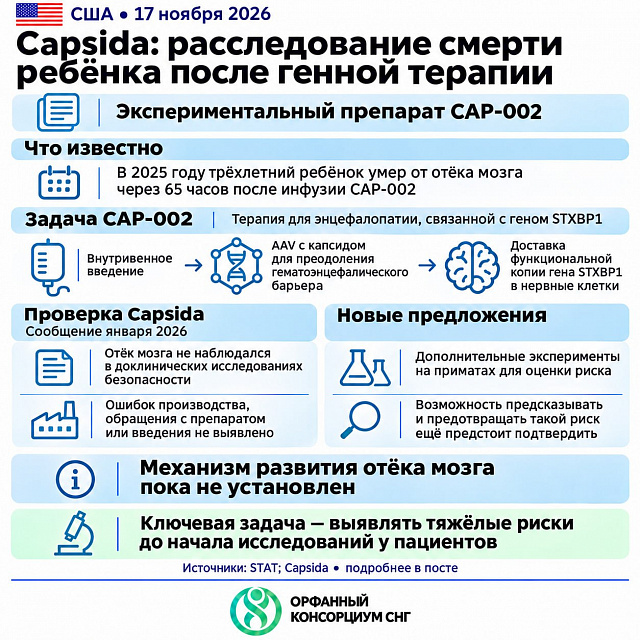
On November 17, 2026, STAT reported new results from the investigation into the death of a three-year-old patient after administration of an experimental gene therapy by Capsida Biotherapeutics.
The child died in 2025 from brain edema 65 hours after the infusion. At the same time, the exact mechanism of the complication has not yet been established. Open overview STAT Morning Rounds, STAT publication on the investigation.
 How the therapy was supposed to work
The drug CAP-002 was being developed to treat a rare encephalopathy associated with disruptions in the STXBP1 gene, which cause severe epileptic seizures and developmental disorders. The goal of treatment was to deliver a functional copy of the gene into nerve cells in order to restore production of the necessary protein.
For this purpose, a vector based on an adeno-associated virus (AAV) with a modified protein shell — a capsid — was used. It was specially engineered to deliver genetic material from the blood into the brain across the blood-brain barrier. This approach potentially makes it possible to affect different areas of the brain after intravenous administration. Capsida preclinical materials.
 What the company reported about the investigation
Back in January 2026, Capsida published preliminary findings:
— brain edema was not observed in the preclinical safety studies on the basis of which the trial began;
— the investigation did not identify errors in manufacturing, handling of the drug, or its administration;
— the autopsy confirmed brain edema as the cause of death, but did not establish what exactly caused its development.
These are the results of the investigation presented by the company itself. Capsida statement.
 What is now proposed
According to STAT, researchers have proposed additional experiments in primates that could help identify such a risk before trials in humans begin.
For now, this concerns the development of an approach to safety assessment. The final cause of the complication has not been established, and the ability to reliably predict and prevent such a risk has yet to be confirmed. STAT, November 17, 2026 — subscription material.
 Why this matters
The investigation of this case is significant for other gene therapy programs for rare neurological diseases that use capsids to cross the blood-brain barrier.
The main question is how to ensure effective delivery of a gene to the brain and identify possible severe complications in advance. The possibility of such delivery requires appropriate approaches to safety testing before proceeding to studies in patients.
The child died in 2025 from brain edema 65 hours after the infusion. At the same time, the exact mechanism of the complication has not yet been established. Open overview STAT Morning Rounds, STAT publication on the investigation.
How the therapy was supposed to workThe drug CAP-002 was being developed to treat a rare encephalopathy associated with disruptions in the STXBP1 gene, which cause severe epileptic seizures and developmental disorders. The goal of treatment was to deliver a functional copy of the gene into nerve cells in order to restore production of the necessary protein.
For this purpose, a vector based on an adeno-associated virus (AAV) with a modified protein shell — a capsid — was used. It was specially engineered to deliver genetic material from the blood into the brain across the blood-brain barrier. This approach potentially makes it possible to affect different areas of the brain after intravenous administration. Capsida preclinical materials.
What the company reported about the investigationBack in January 2026, Capsida published preliminary findings:
— brain edema was not observed in the preclinical safety studies on the basis of which the trial began;
— the investigation did not identify errors in manufacturing, handling of the drug, or its administration;
— the autopsy confirmed brain edema as the cause of death, but did not establish what exactly caused its development.
These are the results of the investigation presented by the company itself. Capsida statement.
What is now proposedAccording to STAT, researchers have proposed additional experiments in primates that could help identify such a risk before trials in humans begin.
For now, this concerns the development of an approach to safety assessment. The final cause of the complication has not been established, and the ability to reliably predict and prevent such a risk has yet to be confirmed. STAT, November 17, 2026 — subscription material.
Why this mattersThe investigation of this case is significant for other gene therapy programs for rare neurological diseases that use capsids to cross the blood-brain barrier.
The main question is how to ensure effective delivery of a gene to the brain and identify possible severe complications in advance. The possibility of such delivery requires appropriate approaches to safety testing before proceeding to studies in patients.