Gene Therapy News
Gene therapy is currently expected to completely cure many hereditary diseases: instead of lifelong replacement or symptomatic therapy, patients will be able to receive a one-time intervention capable of compensating for a genetic defect or disabling a pathological pathway.
However, in practice, this area currently remains under increased scrutiny regarding safety, primarily due to the duration of the effect and the difficulty of monitoring rare delayed events. Let's examine these risks.
In clinical development, there are generally three main technological approaches, each with a different risk profile.
- In vivo vector therapy (usually AAV): delivery of a therapeutic gene to the target tissue; Immune reactions and dose-/route-dependent organ toxicity (often focusing on the liver) are typical.
- Ex vivo modified cells (often integrating vectors): The main risks are associated with integration (clonal expansion/oncogenic events) and conditioning toxicity.
- In vivo genome editing (CRISPR, etc.): Unintended genetic effects (off-target) and the tolerability of systemic delivery are additionally assessed, so monitoring is typically enhanced, especially in the early period. (Review )
Historically, safety signals have set the pace of development in the field. The most famous case is the death of Jesse Gelsinger in 1999 after being given an adenovirus vector in a study on ornithine transcarbamylase deficiency; The event became a turning point for oversight, protocol requirements, and informed consent in gene therapy.
The scale of regulatory pauses in the cell and gene technology segment is disproportionate to their share in the overall body of clinical trials: according to review, such studies make up less than 2% of all clinical trials registered in the database, but they account for about 40% of all regulatory pauses in clinical trials.
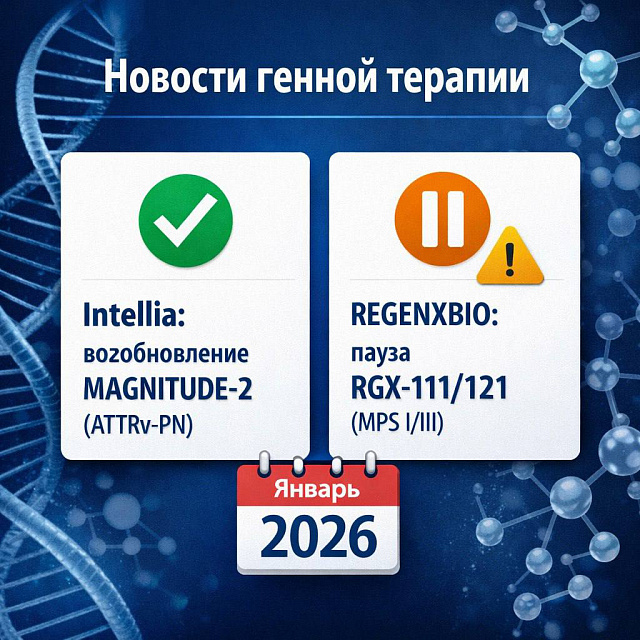
Against this background, 2reviews were published in January 2026. Indicative decisions on clinical gene therapy programs.
Intellia Therapeutics (ATTRv-PN): allowed to resume study after enhanced safety measures.
On January 27, the phase III MAGNITUDE-2 study of nexiguran ziclumeran was allowed to continue (nex-z)—an experimental CRISPR therapy for the treatment of hereditary transthyretin amyloidosis with polyneuropathy (ATTRv-PN). The resumption was made possible after the implementation of enhanced safety monitoring; At the same time, the company announced an expansion of enrollment from approximately 50 to 60 patients, while a separate ATTR cardiomyopathy program remained on regulatory pause.
REGENXBIO (MPS I/II): Two programs were temporarily suspended after a participant was diagnosed with a CNS tumor.
On January 28, the clinical programs RGX-111 (mucopolysaccharidosis I, Hurler syndrome) and RGX-121 (mucopolysaccharidosis II, Hunter syndrome) after the discovery of an intraventricular tumor of the central nervous system in a child who received RGX-111 about four years ago (detection during a routine MRI). No additional tumors were reported among patients treated in either program.
RGX-121 is a single-dose, stand-alone AAV9 therapy designed to deliver the IDS gene to the central nervous system to promote prolonged enzyme production across the blood-brain barrier and address the neurological manifestations of MPS II.
We recognize that gene-cell technologies are the future, but their successful implementation will be determined not only by advances in platforms and manufacturing, but also by the development of regulatory approaches and regulatory science, as well as methods for identifying, interpreting, and managing risks.