UK published SMA patient data used in Spinraza and Evrysdi reassessment
Published 22 September 2026
Last update 23 September 2026
124
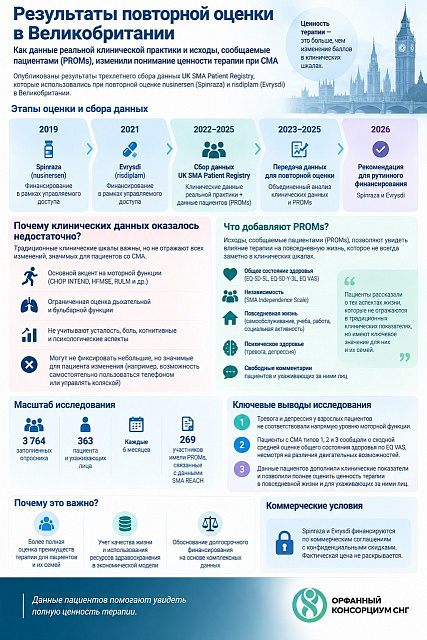
On 3 September, the results of a three-year UK SMA Patient Registry study were published; its data were used in the reassessment of nusinersen (Spinraza) and risdiplam (Evrysdi) in the United Kingdom.
Both drugs initially received NHS funding under managed access agreements: Spinraza — in 2019, Evrysdi — in 2021. Funding was provided amid continued uncertainty — on the condition that additional data would be collected and a subsequent health technology reassessment would be carried out.
 Why Real-World Data Were Needed
The main body of real-world clinical data was collected through the clinical networks SMA REACH UK and Adult SMA REACH.
Physicians recorded motor function, achievement of motor milestones, survival, need for ventilatory support, treatment discontinuation, and other clinical outcomes.
However, during follow-up, an important problem emerged: standard motor scales did not fully reflect the benefit of treatment noted by patients and physicians.
A small change in motor function could substantially change a patient's daily life: for example, enabling them to use a phone independently, operate a power wheelchair, or maintain self-care ability for longer, while barely changing the overall score on the scale.
Motor scales also insufficiently reflected breathing, swallowing, and speech, fatigue, pain, and patient independence.
 Why PROMs Were Added
Therefore, it was decided to supplement the clinical data with PROMs — Patient-Reported Outcome Measures.
In April 2022, the UK SMA Patient Registry launched a dedicated three-year collection of such data. Every six months, patients or parents of children completed questionnaires, including the EQ-5D and the SMA Independence Scale.
Quality of life, general health status, and the ability to perform daily activities independently were assessed.
Over three years, 3,764 questionnaires were received from 363 patients and their caregivers.
PROMs were linked to SMA REACH clinical data, meaning that for a single patient it was possible to compare changes in motor indicators with changes in their quality of life and independence.
 What the Patient Data Showed
The results confirmed that motor function, quality of life, and independence measure different aspects of treatment effect.
For example, in adults, the severity of anxiety and depression was not directly related to the level of motor function. Patients with different types of SMA also reported similar average general health scores, despite pronounced differences in motor abilities.
This is important because, in rare diseases, the clinical effect of treatment is not always fully described by a single scale or a single functional indicator.
 How This Affected the Reassessment
In the reassessment, NICE additionally considered the quality of life of patients and their caregivers, independence, and healthcare resource use — that is, effects that cannot be fully described by a change in a motor scale alone.
In 2026, the reassessment concluded with the transition of Spinraza and Evrysdi to routine NHS funding.
Both drugs are funded under commercial agreements with confidential discounts. Therefore, it is unknown how far the new data directly influenced the size of the discount, but they were incorporated into the updated clinical and economic assessment on which the final funding decision was based.
 Sources:
UK SMA Patient Registry publication
NICE final reassessment
Both drugs initially received NHS funding under managed access agreements: Spinraza — in 2019, Evrysdi — in 2021. Funding was provided amid continued uncertainty — on the condition that additional data would be collected and a subsequent health technology reassessment would be carried out.
Why Real-World Data Were NeededThe main body of real-world clinical data was collected through the clinical networks SMA REACH UK and Adult SMA REACH.
Physicians recorded motor function, achievement of motor milestones, survival, need for ventilatory support, treatment discontinuation, and other clinical outcomes.
However, during follow-up, an important problem emerged: standard motor scales did not fully reflect the benefit of treatment noted by patients and physicians.
A small change in motor function could substantially change a patient's daily life: for example, enabling them to use a phone independently, operate a power wheelchair, or maintain self-care ability for longer, while barely changing the overall score on the scale.
Motor scales also insufficiently reflected breathing, swallowing, and speech, fatigue, pain, and patient independence.
Why PROMs Were AddedTherefore, it was decided to supplement the clinical data with PROMs — Patient-Reported Outcome Measures.
In April 2022, the UK SMA Patient Registry launched a dedicated three-year collection of such data. Every six months, patients or parents of children completed questionnaires, including the EQ-5D and the SMA Independence Scale.
Quality of life, general health status, and the ability to perform daily activities independently were assessed.
Over three years, 3,764 questionnaires were received from 363 patients and their caregivers.
PROMs were linked to SMA REACH clinical data, meaning that for a single patient it was possible to compare changes in motor indicators with changes in their quality of life and independence.
What the Patient Data ShowedThe results confirmed that motor function, quality of life, and independence measure different aspects of treatment effect.
For example, in adults, the severity of anxiety and depression was not directly related to the level of motor function. Patients with different types of SMA also reported similar average general health scores, despite pronounced differences in motor abilities.
This is important because, in rare diseases, the clinical effect of treatment is not always fully described by a single scale or a single functional indicator.
How This Affected the ReassessmentIn the reassessment, NICE additionally considered the quality of life of patients and their caregivers, independence, and healthcare resource use — that is, effects that cannot be fully described by a change in a motor scale alone.
In 2026, the reassessment concluded with the transition of Spinraza and Evrysdi to routine NHS funding.
Both drugs are funded under commercial agreements with confidential discounts. Therefore, it is unknown how far the new data directly influenced the size of the discount, but they were incorporated into the updated clinical and economic assessment on which the final funding decision was based.
Sources:UK SMA Patient Registry publication
NICE final reassessment