EU strengthens patients' role in evaluating new medical technologies
Published 23 September 2026
Last update 23 September 2026
198
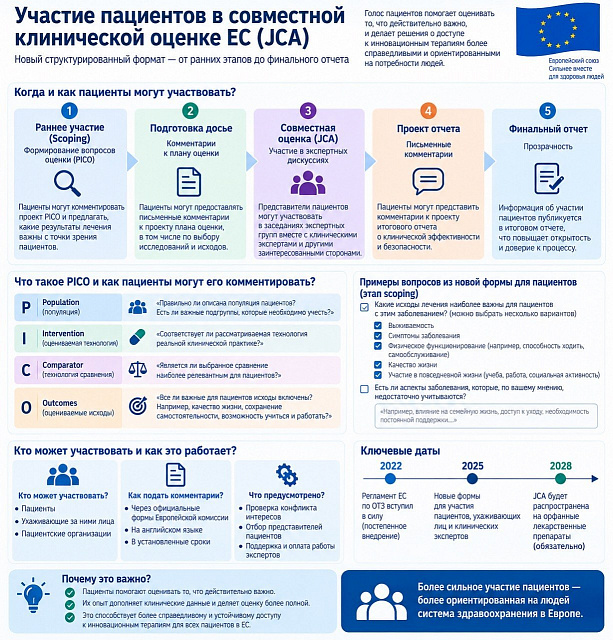
On 14 September, the European Commission presented new tools for the participation of patients, carers, and clinical experts in the joint clinical assessment of medical technologies in the EU.
This assessment is used as a basis for subsequent national decisions on funding, pricing, and access to new drugs.
Patient participation in decisions on access to therapy is not new. In 2025, at least one patient or carer and one clinical expert participated in each EU joint clinical assessment.
Now this participation is becoming more structured.
 What Tools Have Been Published
The European Commission has published three new templates:
— a template for patients and carers to participate at the stage of defining HTA questions;
— a template for clinical experts to participate at the same stage;
— a template for comments from patients, carers, and clinicians on the draft joint clinical assessment report.
 Why This Matters
When conducting an assessment, it is necessary to determine not only whether a new drug is effective, but also for which patients it should be assessed, with which existing treatment it should be compared, and which treatment outcomes should be considered meaningful.
Patients are involved already at the stage of defining the questions that the health technology assessment (HTA) must answer.
They review the draft PICO — Population, Intervention, Comparator, Outcomes: the patient population, the technology being assessed, the comparator technology, and the outcomes to be assessed — and can submit their comments.
For example, for a patient with a rare disease, an important treatment outcome may be not only a change in a laboratory parameter, but also maintaining the ability to move independently, study, work, or avoid constant assistance.
Patients' experience helps to understand the extent to which the outcomes selected for assessment reflect the real consequences of the disease and treatment.
 How This Affects the Assessment
Once the PICO is approved, the questions formulated within it determine which clinical evidence the manufacturer must submit for the joint assessment.
Patients also participate at the next stage: they can review the draft joint clinical assessment report and submit their comments before its final approval.
To participate, one does not need to be an HTA specialist. The patient's role is to present their own experience of living with the disease and of treatment.
At the same time, a formal selection procedure, conflict-of-interest checks, and remuneration for experts' work are provided.
 Significance for Rare Diseases
Currently, the EU joint clinical assessment applies primarily to new oncology drugs and advanced therapy medicinal products, including gene and cell technologies.
From January 2028, it will be extended to all orphan medicinal products.
For rare diseases, a more systematic inclusion of the patient perspective is particularly important.
With a small number of patients and a limited evidence base, their experience can help determine which treatment outcomes truly matter and which data need to be obtained to assess a new technology.
 Sources:
New templates from the European Commission
Procedure for the participation of patients, carers, and clinical experts
European Commission FAQ
This assessment is used as a basis for subsequent national decisions on funding, pricing, and access to new drugs.
Patient participation in decisions on access to therapy is not new. In 2025, at least one patient or carer and one clinical expert participated in each EU joint clinical assessment.
Now this participation is becoming more structured.
What Tools Have Been PublishedThe European Commission has published three new templates:
— a template for patients and carers to participate at the stage of defining HTA questions;
— a template for clinical experts to participate at the same stage;
— a template for comments from patients, carers, and clinicians on the draft joint clinical assessment report.
Why This MattersWhen conducting an assessment, it is necessary to determine not only whether a new drug is effective, but also for which patients it should be assessed, with which existing treatment it should be compared, and which treatment outcomes should be considered meaningful.
Patients are involved already at the stage of defining the questions that the health technology assessment (HTA) must answer.
They review the draft PICO — Population, Intervention, Comparator, Outcomes: the patient population, the technology being assessed, the comparator technology, and the outcomes to be assessed — and can submit their comments.
For example, for a patient with a rare disease, an important treatment outcome may be not only a change in a laboratory parameter, but also maintaining the ability to move independently, study, work, or avoid constant assistance.
Patients' experience helps to understand the extent to which the outcomes selected for assessment reflect the real consequences of the disease and treatment.
How This Affects the AssessmentOnce the PICO is approved, the questions formulated within it determine which clinical evidence the manufacturer must submit for the joint assessment.
Patients also participate at the next stage: they can review the draft joint clinical assessment report and submit their comments before its final approval.
To participate, one does not need to be an HTA specialist. The patient's role is to present their own experience of living with the disease and of treatment.
At the same time, a formal selection procedure, conflict-of-interest checks, and remuneration for experts' work are provided.
Significance for Rare DiseasesCurrently, the EU joint clinical assessment applies primarily to new oncology drugs and advanced therapy medicinal products, including gene and cell technologies.
From January 2028, it will be extended to all orphan medicinal products.
For rare diseases, a more systematic inclusion of the patient perspective is particularly important.
With a small number of patients and a limited evidence base, their experience can help determine which treatment outcomes truly matter and which data need to be obtained to assess a new technology.
Sources:New templates from the European Commission
Procedure for the participation of patients, carers, and clinical experts
European Commission FAQ