🧬 Novartis reaches $7.8 billion deal for mRNA therapy for autoimmune diseases
Published 06 October 2026
Last update 07 October 2026
79
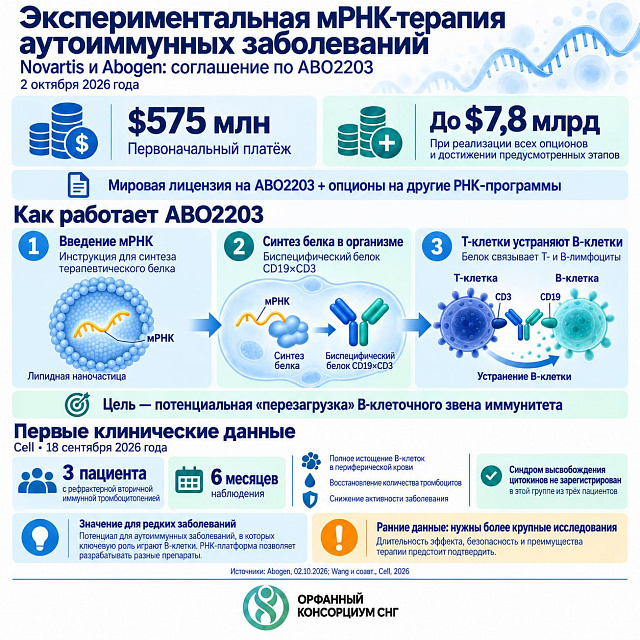
On 2 October, the Chinese company Abogen Biosciences, which develops mRNA therapeutics and vaccines, announced an agreement with Novartis. It provides for the granting of exclusive worldwide rights to the investigational drug ABO2203 and options on other developments based on the company's RNA platform.
The upfront payment will amount to $575 million, and the total amount, upon exercise of all options and achievement of the stipulated milestones, may reach approximately $7.8 billion.
 How the Therapy Works
The distinguishing feature of ABO2203 is that the therapeutic protein is produced directly within the patient's body. The administered mRNA serves as an instruction for the synthesis of a bispecific CD19×CD3 protein, which binds T lymphocytes to B lymphocytes and directs T cells to destroy B cells.
The goal of this approach is to eliminate the B cells involved in the autoimmune process and potentially "reset" the B-cell compartment of the immune system.
 First Clinical Results
The results of the first-in-human study were published in the journal Cell on 18 September. In three patients with refractory secondary immune thrombocytopenia, complete depletion of B cells in peripheral blood, restoration of platelet counts, and a reduction in disease activity were observed over six months of follow-up.
No cytokine release syndrome was recorded in this small group.
 Why This Matters for Rare Diseases
This area is of particular interest for the treatment of rare autoimmune diseases in which B lymphocytes play a key role.
The production of therapeutic proteins within the body using mRNA may form a distinct direction in immunotherapy. The platform nature of the technology opens up opportunities for creating a whole range of drugs, rather than just a single agent for a specific disease.
These are still early clinical data. Durability of effect, safety, and advantages over existing treatments remain to be confirmed in larger studies.
 Source: Abogen Biosciences — announcement of the agreement.
The upfront payment will amount to $575 million, and the total amount, upon exercise of all options and achievement of the stipulated milestones, may reach approximately $7.8 billion.
How the Therapy WorksThe distinguishing feature of ABO2203 is that the therapeutic protein is produced directly within the patient's body. The administered mRNA serves as an instruction for the synthesis of a bispecific CD19×CD3 protein, which binds T lymphocytes to B lymphocytes and directs T cells to destroy B cells.
The goal of this approach is to eliminate the B cells involved in the autoimmune process and potentially "reset" the B-cell compartment of the immune system.
First Clinical ResultsThe results of the first-in-human study were published in the journal Cell on 18 September. In three patients with refractory secondary immune thrombocytopenia, complete depletion of B cells in peripheral blood, restoration of platelet counts, and a reduction in disease activity were observed over six months of follow-up.
No cytokine release syndrome was recorded in this small group.
Why This Matters for Rare DiseasesThis area is of particular interest for the treatment of rare autoimmune diseases in which B lymphocytes play a key role.
The production of therapeutic proteins within the body using mRNA may form a distinct direction in immunotherapy. The platform nature of the technology opens up opportunities for creating a whole range of drugs, rather than just a single agent for a specific disease.
These are still early clinical data. Durability of effect, safety, and advantages over existing treatments remain to be confirmed in larger studies.
Source: Abogen Biosciences — announcement of the agreement.