Roche discontinued development of allogeneic CAR-T therapy RG6540
Published 24 October 2026
Last update 26 October 2026
4
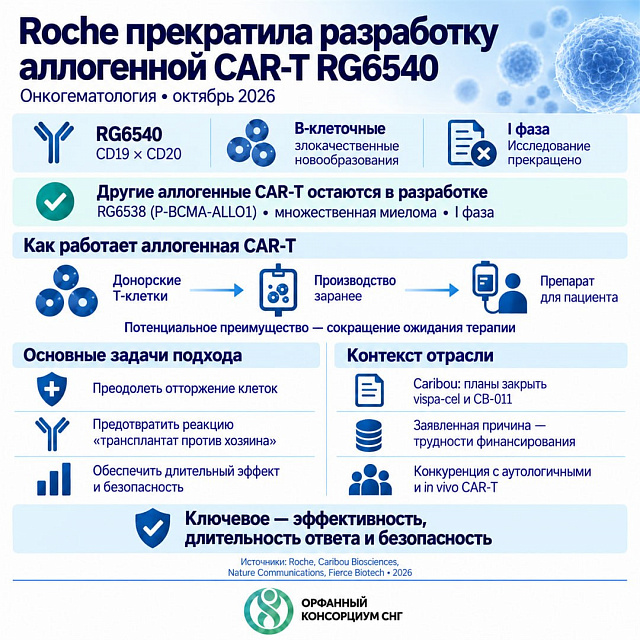
Roche has discontinued the development of the investigational allogeneic CAR-T therapy RG6540 for the treatment of B-cell malignancies. The decision is reflected in the company's third-quarter 2026 materials. The dual-target drug — CD19 and CD20 — entered Roche's portfolio following the acquisition of Poseida Therapeutics. A company representative confirmed the discontinuation of the Phase I clinical trial in oncohaematology to BioSpace.
At the same time, Roche continues to develop other allogeneic CAR-T therapies. In particular, RG6538 (P-BCMA-ALLO1) remains in its portfolio, being studied in Phase I in patients with relapsed or refractory multiple myeloma. Therefore, the decision on RG6540 cannot be regarded as the company abandoning the entire field. Roche materials.
Allogeneic CAR-T is created from donor T lymphocytes. Such products can be manufactured in advance, without the need for individual production from the patient's cells. For patients with rapidly progressing diseases, this potentially allows the time to treatment initiation to be shortened. Nature Communications.
However, developers of this approach face financing difficulties. On 6 October, Caribou Biosciences announced plans to discontinue the development of two allogeneic CAR-T programmes: vispa-cel for the treatment of B-cell non-Hodgkin lymphomas and CB-011 for the treatment of multiple myeloma. The company explained the decision by difficulties in raising capital. At the same time, according to its statement, vispa-cel was already ready to move into Phase III, and the study design had been agreed with the FDA. Caribou announcement.
Along with financial difficulties, biological limitations remain. The patient's immune system may reject donor cells, limiting the duration of their action. At the same time, it is necessary to prevent graft-versus-host disease and to ensure the safety of patient preparation for infusion. These are common challenges in the development of allogeneic CAR-T; the reports cited do not allow them to be regarded as established causes of the discontinuation of specific programmes. Nature Communications.
Additional pressure is created by competition. Autologous CAR-T made from the patient's own cells is being improved, and investment is being attracted by in vivo technologies, in which CAR-T cells are formed directly within the body. In interviews for an industry review by Fierce Biotech, company representatives and analysts note that developers of allogeneic products need to convincingly demonstrate the advantages of their approach and its place in treatment. Fierce Biotech.
The ability to manufacture the product in advance remains an important potential advantage of allogeneic CAR-T. However, its practical value must be confirmed by data on efficacy, duration of response, safety, and accessibility of treatment.