IQVIA estimates that nine out of ten new drugs that entered the US market in 2016-2020 may not pay off
Published 22 November 2026
Last update 23 November 2026
11
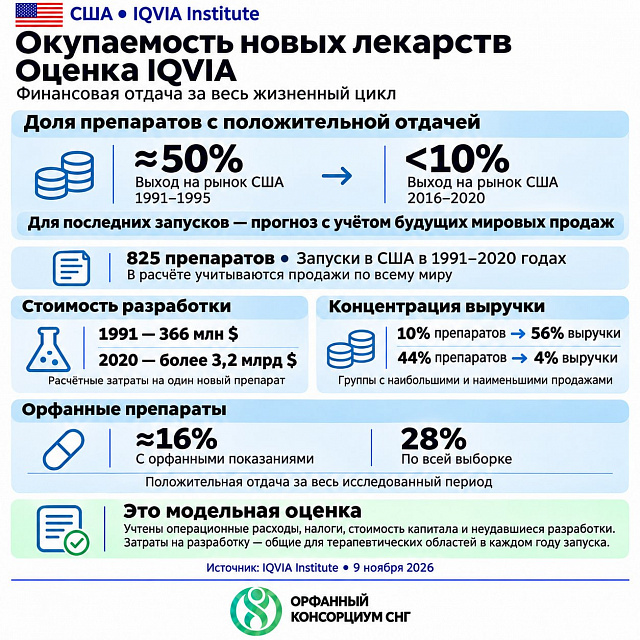
The IQVIA Institute assessed what share of new medicines generates a positive financial return over the entire life cycle. Among medicines that came to the U.S. market in 1991–1995, this figure was approximately 50%. For medicines that came to market in 2016–2020, the forecast is noticeably more modest: even taking into account future global sales, a positive return is expected for less than 10%.
 How the calculation was carried out
The analysis covered 825 medicines. The authors used data on global sales through 2023 inclusive. For 387 medicines whose life cycle has not yet ended, future revenue was forecast.
The calculation took into account operating expenses, taxes, and development costs, including the cost of invested capital and expenses on projects that never reached the market. Thus, the conclusion on profitability is based on a model that takes into account costs and revenues over the entire life cycle of a medicine.
 Development is getting more expensive, while average revenue barely changes
When comparing the two five-year periods — 1991–1995 and 2016–2020 — the estimated development costs on average per one medicine that reached the market increased by a factor of 6.8. At the same time, the average present value of global revenue over the entire life cycle of a medicine increased by only 3%.
Looking at individual years, in 1991 the authors estimated the development cost of one new medicine at 366 million dollars, while in 2020 it was already more than 3.2 billion dollars.
The financial result is largely determined by a small group of medicines. The 10% of medicines with the highest sales account for 56% of total revenue. The share of 44% of medicines with the lowest sales is only 4%.
 What the analysis of orphan medicines showed
Among medicines with orphan indications, according to IQVIA's estimate, approximately one in six generates a positive return.
The high cost of treating one patient may be combined with relatively low revenue over the entire life cycle, since few patients receive treatment. In the study, for 54% of medicines with orphan indications, the present value of global sales over the entire life cycle was less than 1 billion dollars.
Over the entire period studied, the estimated share of medicines with a positive return was 16.1% in the orphan group versus 28% for the sample as a whole.
 How to interpret these results
The orphan group also included medicines that received an indication for the treatment of a rare disease after coming to market. At the same time, for each launch year the authors applied a development cost estimate common to all therapeutic areas.
This feature is important to take into account when comparing the groups: the result depends on the assumptions adopted about costs, the cost of capital, and future sales. It characterizes the financial return within the IQVIA model.
 Source: IQVIA Institute, report of November 9, 2026. Full report (PDF).
How the calculation was carried outThe analysis covered 825 medicines. The authors used data on global sales through 2023 inclusive. For 387 medicines whose life cycle has not yet ended, future revenue was forecast.
The calculation took into account operating expenses, taxes, and development costs, including the cost of invested capital and expenses on projects that never reached the market. Thus, the conclusion on profitability is based on a model that takes into account costs and revenues over the entire life cycle of a medicine.
Development is getting more expensive, while average revenue barely changesWhen comparing the two five-year periods — 1991–1995 and 2016–2020 — the estimated development costs on average per one medicine that reached the market increased by a factor of 6.8. At the same time, the average present value of global revenue over the entire life cycle of a medicine increased by only 3%.
Looking at individual years, in 1991 the authors estimated the development cost of one new medicine at 366 million dollars, while in 2020 it was already more than 3.2 billion dollars.
The financial result is largely determined by a small group of medicines. The 10% of medicines with the highest sales account for 56% of total revenue. The share of 44% of medicines with the lowest sales is only 4%.
What the analysis of orphan medicines showedAmong medicines with orphan indications, according to IQVIA's estimate, approximately one in six generates a positive return.
The high cost of treating one patient may be combined with relatively low revenue over the entire life cycle, since few patients receive treatment. In the study, for 54% of medicines with orphan indications, the present value of global sales over the entire life cycle was less than 1 billion dollars.
Over the entire period studied, the estimated share of medicines with a positive return was 16.1% in the orphan group versus 28% for the sample as a whole.
How to interpret these resultsThe orphan group also included medicines that received an indication for the treatment of a rare disease after coming to market. At the same time, for each launch year the authors applied a development cost estimate common to all therapeutic areas.
This feature is important to take into account when comparing the groups: the result depends on the assumptions adopted about costs, the cost of capital, and future sales. It characterizes the financial return within the IQVIA model.
Source: IQVIA Institute, report of November 9, 2026. Full report (PDF).