SMA: experience of the Republic of Armenia, Belarus and Uzbekistan |II CIS Orphan Forum|Moscow, June 27, 2025
Published 14 July 2025
Last update 29 September 2025
615
The issues of availability of therapy, development of registries, the role of charitable initiatives and the potential for intercountry cooperation were discussed.
Republic of Armenia
- Gasparyan Nadezhda Valerievna, Medical Center "Arabkir" of the Institute of Child and Adolescent Health
Availability of therapy:
- There is no neonatal screening for SMA
- None of the modern pathogenetic drugs are registered
- Treatment is not available in the country - families are forced to seek medical help abroad
Diagnostics:
- There are several specialized diagnostic centers
- 222 patients have been identified in the Center for Medical Genetics and Primary Health Care over 20 years
- The main focus is on prenatal and preimplantation diagnostics
- Patients are accompanied by individual doctors and specialists - there is no systemic support
- Only individual patients receive medications - at the expense of charitable foundations
- Representatives of Armenia expressed hope for the development of cooperation with medical centers of the CIS, which could accept children for treatment regardless of citizenship.
Republic of Belarus
- Elena Anatolyevna Kalinina, Deputy Director of the State Institution Republican Scientific and Practical Center "Mother and Child"
Monitoring and diagnostic system:
- Since 2021, a department for hereditary neuromuscular diseases has been operating at the Mother and Child Republican Scientific and Practical Center
- A registry is maintained that includes 98 children with SMA
- Adult patients are monitored at a specialized neurology center
- Diagnostics are free, including molecular genetic methods
- All three drugs (Zolgensma, Spinraza, Risdiplam) are registered and included in the list of orphan diseases and drugs
- However, there is no sustainable government funding, and treatment is not available to most patients
- A charity fund was opened in 2023 account, which is used to purchase drugs, primarily Zolgensma, for a limited number of children
- Decisions on provision are made by the Republican Council
- The concept for launching neonatal screening has been approved
- Implementation is expected closer to 2030
- The patient organization "Genome" plays an active role, interacting with doctors and government agencies.
Republic of Uzbekistan
- Saifutdinov Zainitdin Asamutdinovich, Deputy Director of the Republican Specialized Scientific and Practical Center for Pediatrics
General situation:
- Over the past 3 years, a comprehensive model of care for patients with SMA has been built
- About 295 patients have been officially registered
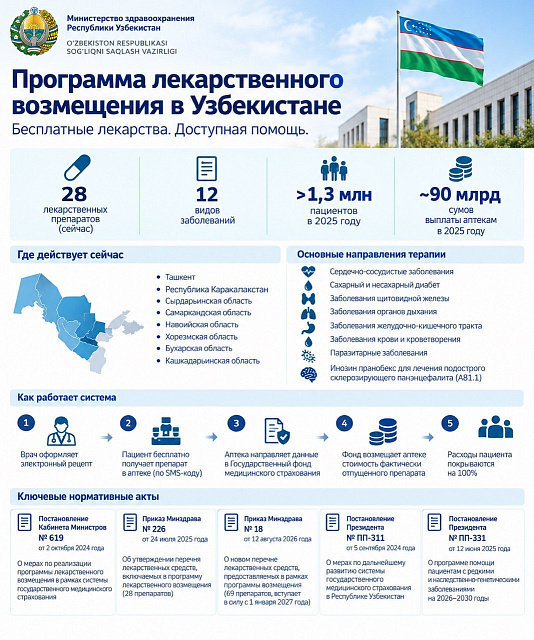
- In 2022, a presidential decree was signed on free provision of pathogenetic therapy for children
- 76 patients received treatment in the first year
- The main drug is Risdiplam
- Negotiations are underway to register Spinraza and Zolgensma
- All patients are referred to a specialized department of the Republican Psychoneurological Hospital named after Kurbanova
- Molecular diagnostics laboratories are being developed in the regions (Tashkent, Fergana, Samarkand)
- Screening is being implemented among pregnant women from the risk group
- The SMA-Umid charity fund is actively working
- Annual trainings for parents are being held, including with the participation of specialists from Russia
Conclusions of the session:
The CIS countries are forming an aid infrastructure, but access to treatment remains uneven. Participants emphasized the importance of:
- early access mechanisms
- institutional support for families
- sustainable sources of funding
- opportunities for therapy outside the country of origin
- and the formation of a network of intercountry interactions.